
With global internet diffusion comes the risk of experiencing hate messages and seeing violent images – yet some high-connectivity countries do manage to maintain low exposure.
Based on comparative analyses we ran in 2021 using as many countries as available from the Global Kids Online, EU Kids Online, and UNICEF Disrupting Harms projects, a new research brief published by UNICEF’s Global Office of Research and Foresight is now available.
Internet diffusion and internet use are increasing globally. Governments invest in infrastructure and households spend money on devices and data plans, so they clearly expect benefits from digital connectivity. Yet at the same time, incidental exposure to potentially harmful content may increase. Therefore, the prevalence of children’s exposure to two instances of potentially harmful content – hate messages against certain individuals or groups and gory or violent images – were examined cross-nationally, with the idea of working with governments and companies to curb such exposure.

Countries located underneath the “hump” of the fitted line in the figures below seem to be doing some things right. A possible interpretation is that when countries reach 50% internet penetration (before 50%, riks doesn’t increase with internet diffusion), risks may increase exponentially, and it becomes a question of a governance mix to bring them back down (while retaining the opportunities offered by the internet). Some countries seem to succeed in this (for example, Germany, Slovakia, New Zealand, Uruguay), others stay on the growing risks trajectory (for example, Poland, Czech Republic, Serbia, Philippines).
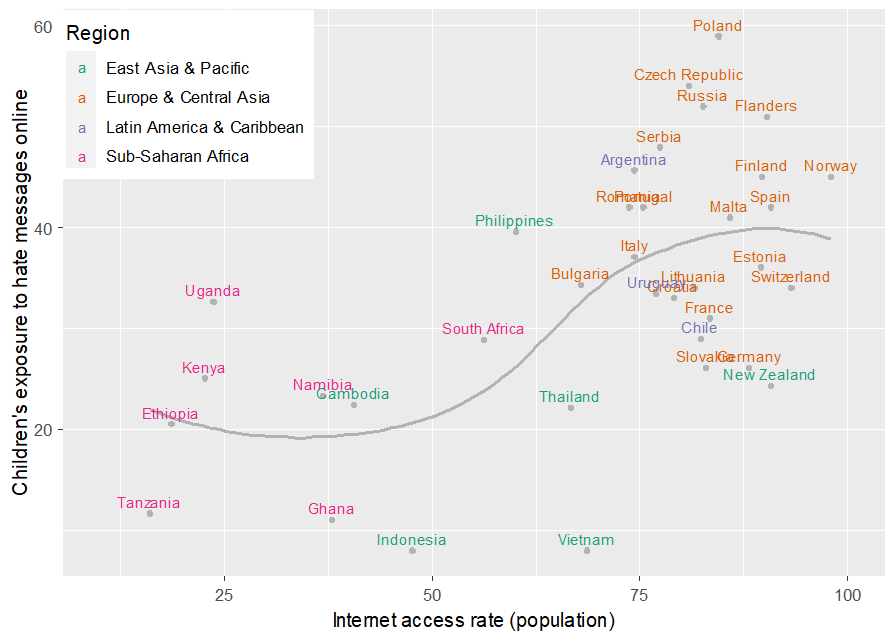
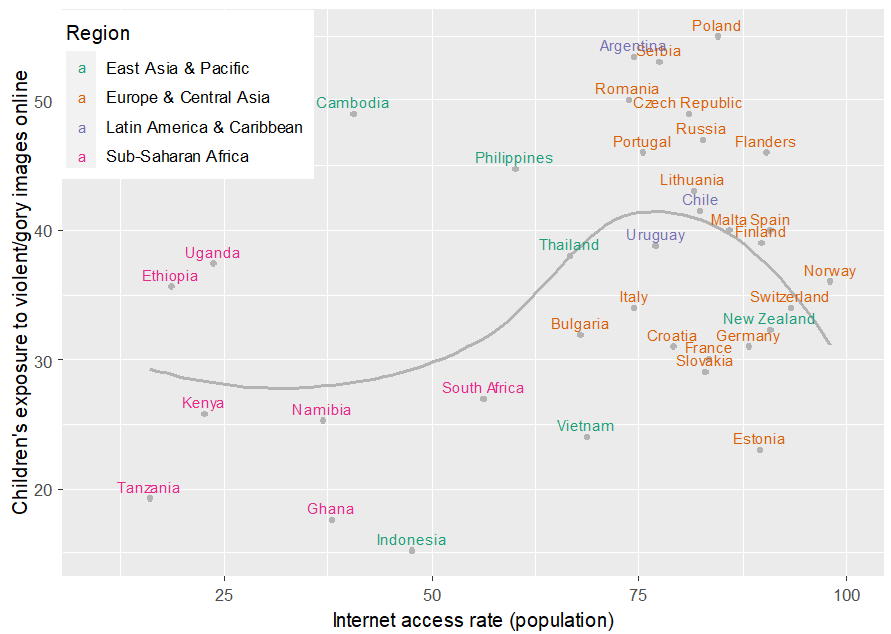
Some countries that are still developing their internet infrastructure and are at similar diffusion rates (at around one third of the population) still vary greatly in adolescents’ risk exposure (Cambodia, Ghana, Indonesia). Exposure to hate messages and violent/gory images is highly correlated and generally at similar levels, as expected. Some have comparably much higher levels of violent/gory images (e.g., Cambodia), whereas others have higher levels of hate messages (e.g., Estonia).
At the individual level of kids’ use (as opposed to national percentages), the correlation with frequency of use and potentially harmful content exposure is r=.08 for hate messages and r=.12 for violent/gory images (based only on Disrupting Harm data where we have this granularity). In terms of effect size this is very small, which is a good thing: More frequent use doesn’t automatically increase exposure to potentially harmful content for an indivual. Access and frequency of use are not the same thing, but this should still caution against ecological fallacy: in this case, across countries, higher access does mean more exposure (r=.58 for hate messages; r=.37 for violent/gory images; N = 36 countries), but within a country, higher usage is only minimally related to increased exposure as noted above (and since the presumed relevant process takes place at the individual level – kids use the internet more and may be subjected to harms – the more relevant finding here is the r=.08/.12). A potential explanation is that this may be moderated by skills such that an increase in use only leads to more harmful content exposure if skills don’t also increase, clearly pointing to education and policy.
There is a need to engage industry stakeholders and platform companies to report on what data they have
of hate messages or violent content proliferating on their services and the measures they are taking to
prevent it.
 Media & Society